Uncategorized
Kawah Ijen Acid Lake — The World’s Most Acidic Crater Lake Explained
Understand ijen crater acid lake tour safety. Learn about Kawah Ijen's hyperacidic pH 0.3 turquoise lake, its toxic chemistry, and vital trekker safety on
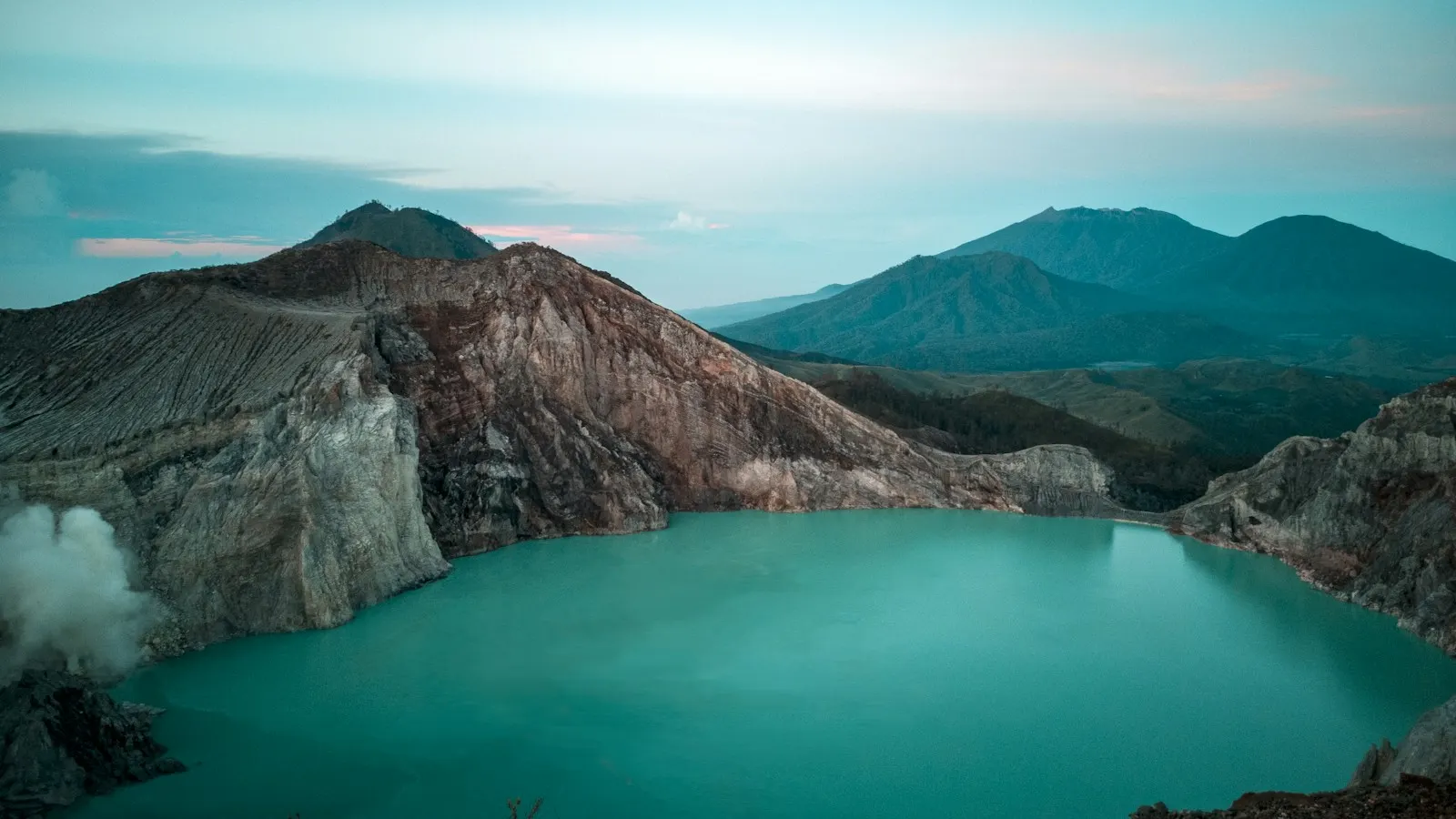
Kawah Ijen’s crater acid lake is the world’s largest and most acidic, presenting unique challenges and requiring strict safety protocols for any tour. Understanding the nature of this extraordinary body of water is crucial for ijen crater acid lake tour safety, ensuring visitors appreciate its beauty without risking harm.
What is Kawah Ijen’s Acid Lake? A Geochemical Wonder and a Warning
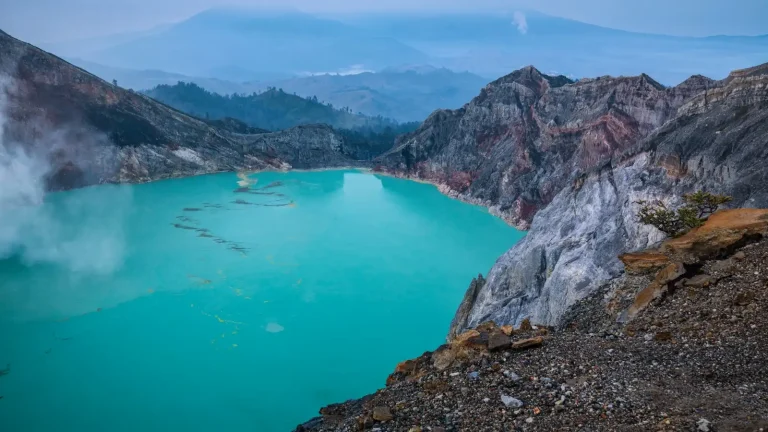
At the heart of the Kawah Ijen volcano in East Java, Indonesia, lies a vast, otherworldly lake. This kawah ijen turquoise lake crater is not merely a scenic attraction; it is the world’s largest hyperacidic crater lake, a potent solution of sulfuric and hydrochloric acids. Its striking milky-turquoise color, though visually captivating, is a direct indicator of its extremely corrosive nature.
The lake’s formidable acidity is a key characteristic. Scientific measurements have consistently recorded the kawah ijen ph 0.3 hyperacid lake temperature, placing it among the most acidic natural bodies of water on Earth. To put this into perspective, battery acid typically has a pH of around 1.0. Kawah Ijen’s lake, with a pH often dipping below 0.3, is significantly more acidic, making it a truly extreme environment.
This hyperacidity isn’t static; it’s a dynamic system fueled by the active volcanic vents beneath the lake’s surface. Gases like sulfur dioxide (SO2) and hydrogen sulfide (H2S) are continuously emitted, reacting with the water to form potent acids. These chemical processes define the lake’s unique character and pose significant hazards.
The Science of the Kawah Ijen Turquoise Lake’s Color
The mesmerizing kawah ijen turquoise crater lake mineral chemistry is responsible for its iconic hue. The vivid color isn’t just about the acid; it’s a direct result of high concentrations of dissolved metals. As the volcanic gases interact with the rock and water, they leach out various minerals. Iron, aluminum, and copper, alongside sulfur compounds, are suspended in the acidic solution. It is the scattering of light by these finely dispersed mineral particles and sulfur colloids that gives the lake its distinctive turquoise-to-blue-green appearance.
This vibrant color, therefore, serves as a visual fingerprint of the lake’s extreme chemistry. While other crater lakes might be blue or green due to algae or less reactive mineral content, Kawah Ijen’s specific shade is a marker of its highly acidic, metal-rich composition. Visitors are often drawn to this color, but understanding its origin reinforces the need for caution.
Why the Turquoise is a Warning: Ijen Crater Turquoise Water Toxic Swimming Danger
The inviting appearance of the kawah ijen turquoise crater lake water often leads to a common, yet dangerous, misconception: that it might be suitable for swimming or even just touching. Nothing could be further from the truth. The ijen crater turquoise water toxic swimming danger is absolute and lethal.
The lake is not merely irritating; it is profoundly corrosive. Direct contact with the water would cause severe chemical burns to human skin, eyes, and respiratory system. Ingesting even a small amount would be fatal, as the acids would rapidly destroy internal tissues and organs. This isn’t a “don’t drink the tap water” scenario; this is a “do not touch this water under any circumstances” warning.
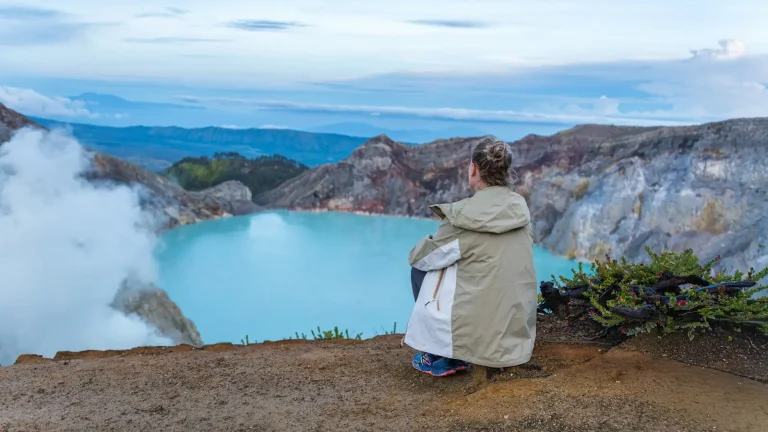
The potential for harm extends beyond direct contact. The gases rising from the lake, particularly sulfur dioxide, can create an acidic mist. While trekking along the rim, especially when the wind shifts, particles of this mist can reach visitors. This is why proper respiratory protection, typically a gas mask, is a non-negotiable item for anyone descending into the crater or standing on the rim for an extended period. Our guides always emphasize the importance of using your mask correctly and listening to their instructions regarding gas conditions.
Ijen Crater Acidity and Sulfur Lake Hazard: More Than Just pH
The ijen crater acidity sulfur lake hazard isn’t solely defined by its pH. While the extreme acidity is primary, the sheer volume of dissolved sulfur compounds contributes significantly to its toxicity. The lake is essentially a massive natural reservoir of highly concentrated chemicals.
Here’s a breakdown of the key hazards:
- Sulfuric Acid (H2SO4): Formed when sulfur dioxide gas reacts with water. This is a powerful dehydrating agent and highly corrosive.
- Hydrochloric Acid (HCl): Also present, contributing to the overall acidity and corrosive properties.
- Dissolved Metals: High concentrations of heavy metals like iron, aluminum, and copper are dissolved in the acid. These are toxic if ingested or absorbed through skin.
- Sulfur Colloids: Fine particles of elemental sulfur are suspended in the water, contributing to the milky appearance and potentially causing skin irritation upon contact.
This complex chemical cocktail means that the lake is a multi-faceted threat. It’s not just “sour water”; it’s a dynamic, chemically active environment that demands respect and distance.
Is it Safe to Swim in Ijen Crater Lake? A Resounding NO.
To directly address the question: is it safe to swim in ijen crater lake? The answer is an unequivocal and absolute NO. Swimming in Kawah Ijen’s crater lake is not only unsafe; it is a guaranteed path to severe injury or death. There are no exceptions, no special areas, and no circumstances under which it would be safe.
Any tour operator, guide, or local who suggests otherwise is providing dangerous misinformation. Reputable guides and park authorities strictly prohibit any contact with the lake for the safety of visitors. Our commitment to your well-being means we will always enforce this critical rule.
Ijen Crater Lake Temperature: A Common Misconception
Many visitors, seeing the volcanic context, assume the ijen crater lake temperature water must be hot, perhaps even boiling. This is a common misconception. While Kawah Ijen is an active volcano with extremely hot gases emanating from its vents, the main body of the crater lake itself is generally cool.
The lake acts as a massive heat sink. Despite the continuous input of hot gases and volcanic activity beneath, the sheer volume of water (estimated at over 200 million cubic meters) dissipates the heat effectively. Surface temperatures are typically reported to be around 25-35°C (77-95°F), which is warm to the touch but far from boiling or even hot spring temperatures.
The hot, acidic gases are vented through fumaroles below and around the lake, where sulfur miners work, and where the blue fire phenomenon occurs. These vents are localized areas of intense heat, but they do not heat the entire lake to a high temperature. Understanding this distinction is important for safety; while the lake isn’t scalding hot, its danger lies in its chemical composition, not its temperature.
Real Safety Implications for Trekkers on the Rim
For trekkers, the primary safety implications when visiting Kawah Ijen revolve around the sulfur gas and the terrain, not direct contact with the lake (which is strictly avoided).
Sulfur Gas: The Invisible Threat
The most immediate hazard for trekkers, especially those descending into the crater to see the blue fire, is the sulfur gas. Kawah Ijen is renowned for its continuous emission of sulfur dioxide (SO2) and, to a lesser extent, hydrogen sulfide (H2S). These gases are highly irritating to the eyes and respiratory system.
- Sulfur Dioxide (SO2): Pungent, suffocating smell. Causes burning eyes, coughing, shortness of breath. High concentrations can be life-threatening.
- Hydrogen Sulfide (H2S): Smells like rotten eggs. Can quickly deaden the sense of smell, making its presence harder to detect at dangerous concentrations. Also highly toxic.
When the wind shifts, or when one is in the lower parts of the crater, gas clouds can suddenly engulf an area. This is why a proper, functioning gas mask is absolutely essential. Our tours provide high-quality gas masks for all participants, and our licensed guides instruct you on their correct use. They continuously monitor gas conditions and will direct you to put on your mask or move to a safer area as needed. Ignoring gas warnings or not wearing your mask is extremely risky.
The Treacherous Terrain: A Physical Challenge
The trek to Kawah Ijen’s rim, and especially the descent into the crater for the blue fire, is physically demanding.
- Paltuding to Crater Rim: The path from the Paltuding entrance gate to the crater rim is approximately 3 kilometers long, with a significant elevation gain of about 800 meters. The trail is mostly uphill, steep in places, and consists of compacted earth, loose gravel, and volcanic sand. It can be slippery, particularly in the dark or after rain.
- Descent to Blue Fire: The path down into the crater to the blue fire spot is even more challenging. It’s roughly 800 meters, very steep, rocky, and often covered in loose volcanic scree. Visibility is poor in the pre-dawn darkness, and the presence of gas can further obscure vision. This section requires careful footing and close attention to the guide’s instructions.
Proper footwear (sturdy hiking shoes, not sandals or casual sneakers), warm layers (temperatures can drop significantly at altitude and in the pre-dawn hours), and a headlamp are critical. Our guides are trained to assist you safely across this terrain, offering a steadying hand where needed and setting a manageable pace.
Planning Your Kawah Ijen Blue-Fire and Crater-Rim Tour
Ensuring a safe and enjoyable Kawah Ijen experience requires meticulous planning and an understanding of logistics. Our tours are designed to handle every detail so you arrive at Paltuding rested and ready, not stranded.
Getting to Kawah Ijen: Routes and Transfers
As Galih Pratomo, East Java Logistics & Routes Researcher, my job is to map and pressure-test every route into Ijen. We understand the journey is a significant part of the experience.
- From Bali (Ketapang Ferry Crossing): Many visitors come from Bali. The journey involves a drive to Gilimanuk port, a 45-60 minute ferry crossing to Ketapang (Banyuwangi, Java), followed by a 1.5-2 hour drive to Paltuding. We coordinate ferry schedules and private transfers to ensure seamless connections, often starting late at night from Bali to reach Ijen in time for the blue fire.
- From Banyuwangi: The closest major city, a 1.5-2 hour drive to Paltuding. Ideal for those already in East Java.
- From Bondowoso: Approximately a 2.5-3 hour drive to Paltuding. Often used as a base for Ijen tours.
- From Surabaya or Malang: Longer drives, typically 6-7 hours. These routes are often integrated into multi-day itineraries, perhaps combining Kawah Ijen with Bromo and Tumpak Sewu.
Our team at Bali Premium Trip plans these transfers with real-world timings, factoring in potential traffic, ferry wait times, and rest stops. We aim for you to arrive at Paltuding around 1:00-2:00 AM, allowing sufficient time for registration and the trek without feeling rushed or overtired.
A Typical Ijen Blue Fire and Crater Rim Tour Itinerary
A standard Kawah Ijen blue-fire and crater-rim tour with us typically follows this pattern:
- Late Night Departure: Depending on your starting point (Bali, Banyuwangi, etc.), pick-up is usually between 7:00 PM and midnight.
- Arrival at Paltuding: Arrive at the Ijen entrance gate (Paltuding) around 1:00 AM – 2:00 AM.
- Briefing and Trek Start: Meet your licensed local guide, receive your gas mask, and get a safety briefing. Begin the trek to the crater rim.
- Descent to Blue Fire (Optional/Conditions Permitting): If conditions are safe (low gas, clear path), your guide will lead you down into the crater to witness the blue fire phenomenon, visible only in complete darkness before sunrise. This is the most challenging part of the trek.
- Crater Rim View & Sunrise: Ascend back to the crater rim to witness the sunrise over the turquoise lake, offering spectacular views as the light reveals the full panorama.
- Return Trek: Trek back down to Paltuding.
- Breakfast & Transfer: Enjoy a well-deserved breakfast before being transferred back to your accommodation or onward destination.
Our itineraries are carefully crafted to balance seeing the incredible sights with your safety and comfort. We prioritize proper rest and hydration, especially given the late-night start.
What to Expect and What to Bring
- Physical Demands: The trek is moderately challenging. A reasonable level of fitness is required.
- Weather: Can be cold at night (temperatures can drop to 5-10°C / 40-50°F on the rim) and warm during the day. Dress in layers.
- Essential Gear: Sturdy hiking shoes, warm jacket, long pants, headlamp (provided on our tours, but a personal one is good), gas mask (provided), small backpack, water, snacks.
- Guide: A licensed, vetted local guide is mandatory for safety and park regulations. They are invaluable for navigation, gas monitoring, and cultural insights.
Booking Your Ijen Tour with Bali Premium Trip
We, at Ijen Tour Package, are operated by Bali Premium Trip, a company founded in 2015 in Kuta, Bali. We are an independent, honesty-first guide and booking service. We plan and run private, expert-guided Ijen treks with our own Bali team, plus licensed, vetted on-ground guides, permits, and transfers. All bookings are handled directly by the Bali Premium Trip reservations team.
When you book with us, you are booking directly with the operator. We do not use third-party markups; our rates are transparent and published. We arrange all necessary third-party services such as park jeeps, local guides, and permits via our network of licensed local partners, ensuring you receive authentic, high-quality service.
An indicative price range for a private 2-day/1-night Kawah Ijen tour from Bali, including transfers, ferry, guide, and entry fees, might be US$250-450 per person, varying by group size, specific inclusions, and season (last verified June 2026). Longer, multi-day tours combining Ijen with Bromo and Tumpak Sewu would, of course, be a higher investment. We always provide a detailed, itemized quote.
Ready to explore Kawah Ijen safely and responsibly? We invite you to plan your trip with us. Our team is available via WhatsApp to discuss your itinerary and answer any questions you may have.
Frequently Asked Questions
Is Kawah Ijen dangerous for tourists?
Kawah Ijen can be dangerous if safety precautions are ignored. The primary risks are exposure to toxic sulfur gases and the challenging, steep terrain. However, with a licensed guide, proper equipment (like a gas mask), and adherence to safety instructions, the risks are significantly mitigated, making it a safe and rewarding experience for trekkers.
What does a pH of 0.3 mean for the lake?
A pH of 0.3 means the lake is extremely acidic, similar to or even stronger than concentrated battery acid. This level of acidity makes the water lethally corrosive to human skin and tissues, dissolving organic matter on contact. It is imperative to never touch or enter the lake.
Why is the lake at Kawah Ijen so blue?
The lake’s vibrant turquoise-to-blue-green color is due to the high concentration of dissolved metals, such as iron, aluminum, and copper, alongside sulfur compounds. These minerals are leached from the volcanic rock by the sulfuric and hydrochloric acids in the water, and their presence causes light to scatter in a way that produces the characteristic color.
Do I need a gas mask at Kawah Ijen?
Yes, a gas mask is absolutely essential when visiting Kawah Ijen, especially if you plan to descend into the crater for the blue fire or if gas conditions are present on the rim. Sulfur dioxide gas is continuously emitted and can cause severe respiratory irritation and other health issues. Our tours provide high-quality gas masks and guidance on their use.
What is the best time to visit Kawah Ijen?
The dry season, typically from April to October, is generally considered the best time to visit Kawah Ijen. During these months, the weather is more stable, with less rain, which means clearer skies for stargazing and sunrise, and less slippery trekking paths. The blue fire is best seen in complete darkness, so a pre-dawn trek is always required regardless of the season.